
In the 2004 movie Mean Girls, Cady Heron lets her calculus grade slip to spend time with Aaron Samuels, under the guise of needing math tutoring. To earn extra credit, she joins the North Shore Mathletes who reach the finals of the state championship.
During the competition, Cady is shown solving the following limit to win the championship for her team:
x→0lim1−cos2(x)ln(1−x)−sin(x)
We can solve this problem in two ways.
L’Hôpital’s Rule
If we directly substitute x=0 into the limit expression, we get:
1−cos2(0)ln(1−0)−sin(0)=1−10−0=00
This is an indeterminate form, so we can apply L’Hôpital’s Rule. If the limit of a function results in an indeterminate form, we can take the derivative of the numerator and denominator separately and then compute the limit again.
Taking the derivative of the numerator and denominator:
dxd[ln(1−x)−sin(x)]=−1−x1−cos(x)
dxd[1−cos2(x)]=2cos(x)sin(x)
So the limit becomes:
x→0lim2cos(x)sin(x)−1−x1−cos(x)
As x→0, the numerator approaches −2, while the denominator approaches 0. But the direction matters:
- When x→0+, sin(x)>0, so the denominator is positive → the expression goes to −∞.
- When x→0−, sin(x)<0, so the denominator is negative → the expression goes to +∞.
Since the left and right sides blow up in opposite directions, the limit does not exist.
Taylor Series
First, let’s simplify 1−cos2(x) in the denominator using the identity 1−cos2(x)=sin2(x). So the limit becomes:
x→0limsin2(x)ln(1−x)−sin(x)
Another way to solve this limit is by using Taylor series expansions around x=0. Taylor expansions approximate functions as infinite sums built from their derivatives at a point.
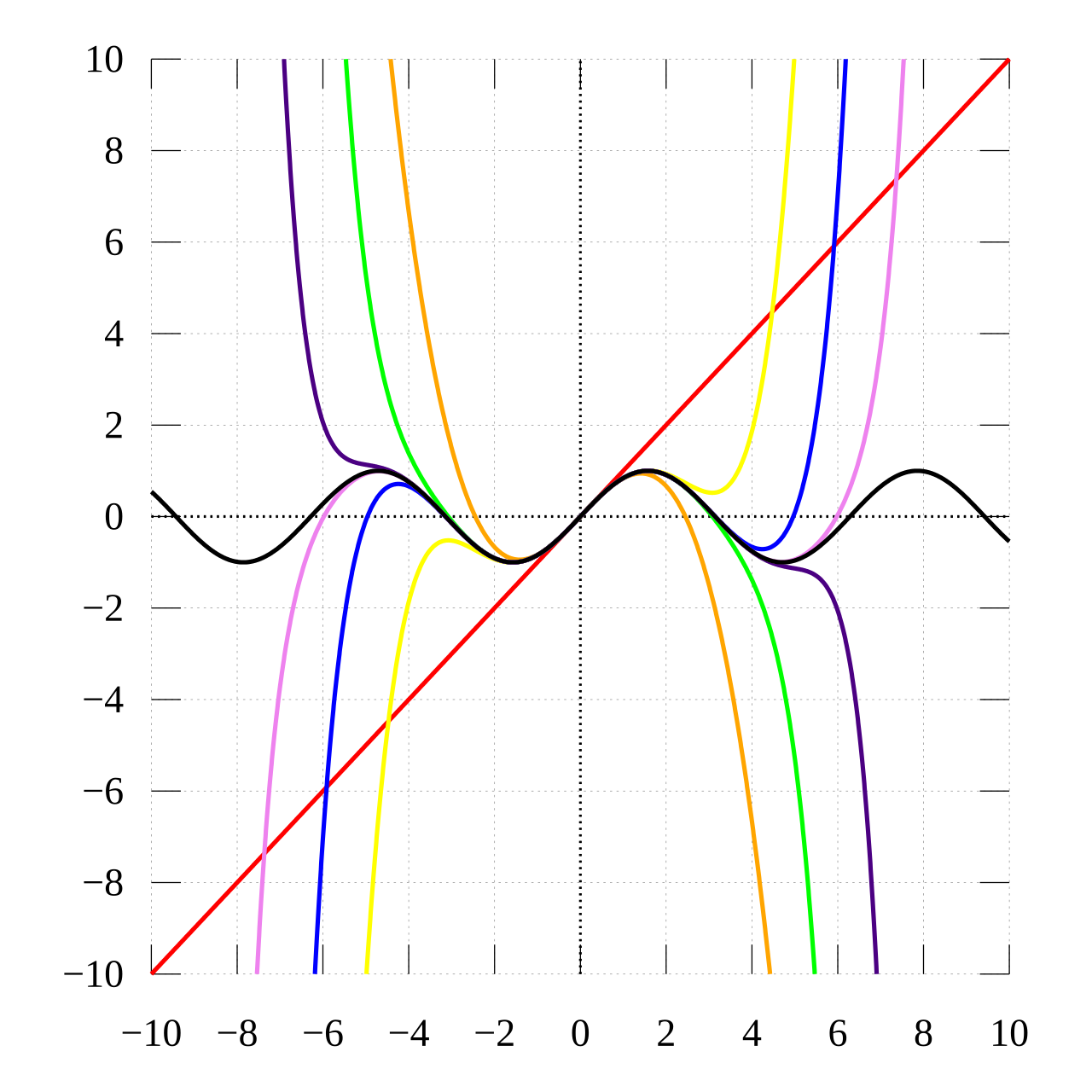
The image above shows sin(x) and its Taylor approximations by polynomials of degree 1, 3, 5, 7, 9, 11, and 13 at x=0. Notice that as the degree of the Taylor polynomial rises, it approaches the correct function.
The Taylor series expansion for a given function f(x) around the point a is given by:
f(a)+1!f′(a)(x−a)+2!f′′(a)(x−a)2+⋯=n=0∑∞n!f(n)(a)(x−a)n
When a=0, the Taylor series is also called the Maclaurin series:
f(0)+1!f′(0)x+2!f′′(0)x2+⋯=n=0∑∞n!f(n)(0)xn.
Let’s first do the Maclaurin series expansions for ln(1−x). We start by calculating the derivatives of f(x)=ln(1−x):
f′(x)=−1−x1,f′′(x)=−(1−x)21,f(3)(x)=−(1−x)32!,f(4)(x)=−(1−x)43!
Substituting these derivatives into the Maclaurin series formula with x=0, we get:
ln(1−x)=−x−2x2−3x3−4x4−⋯
Now let’s do the same for sin(x). The derivatives of f(x)=sin(x) are:
f′(x)=cos(x),f′′(x)=−sin(x),f(3)(x)=−cos(x),f(4)(x)=sin(x)
Substituting these derivatives into the Maclaurin series formula with x=0, we get:
sin(x)=x−3!x3+5!x5−7!x7+⋯
Now we can substitute these series expansions into our limit expression. First the numerator:
ln(1−x)(−x−2x2−3x3−⋯)=−2x−2x2−sin(x)−(x−6x3+⋯)−65x3+⋯
Next the denominator:
sin2(x)=(x−6x3+⋯)2=x2−62x4+⋯=x2−3x4+⋯
We only care about the leading terms in the numerator (−2x) and denominator (x2). All other terms involve higher powers of x and become insignificant as x→0. So we can approximate the limit as:
x→0limx2−2x=x→0limx−2
As x→0+, x−2→−∞, while as x→0−, x−2→+∞. Since the left-hand and right-hand limits differ, the limit does not exist.