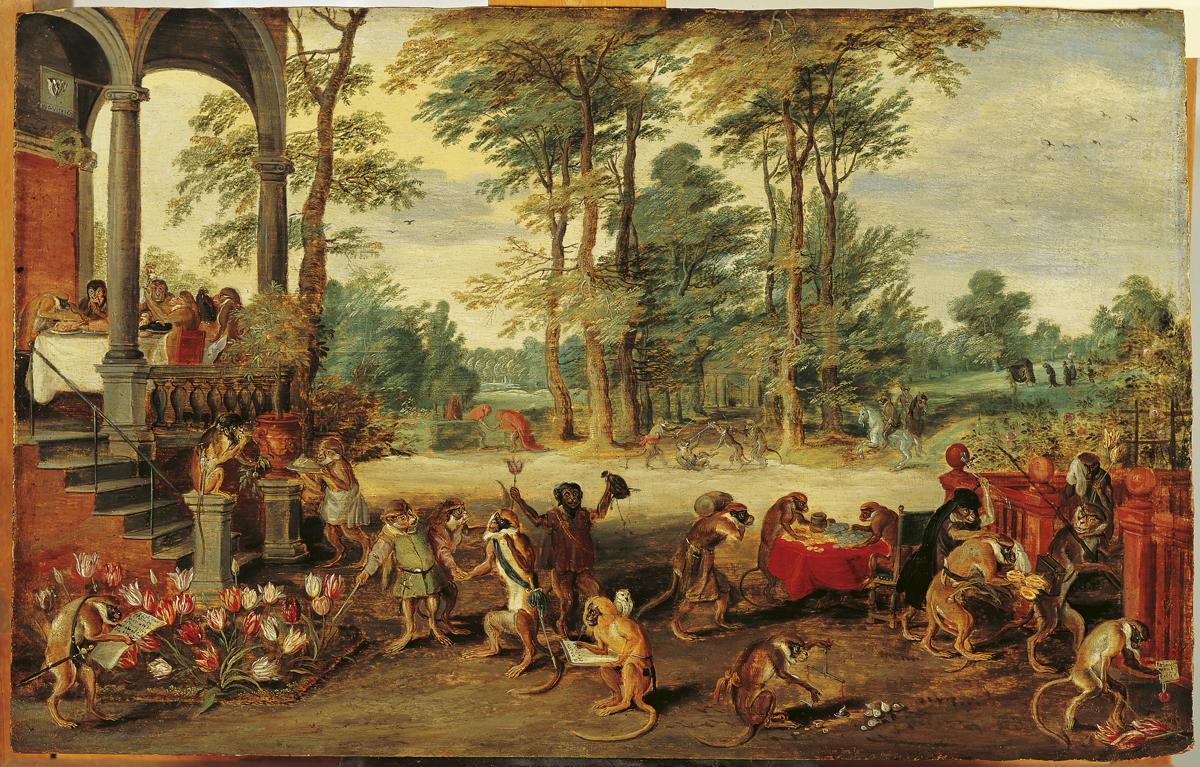
A Satire of Tulip Mania by Jan Brueghel the Younger (c. 1640), shown above, depicts tulip speculators as monkeys dressed in upper-class clothing, mocking the excess, debt, and ruin associated with the episode.
Tulip mania was a period in the Dutch Golden Age when prices for certain tulip bulbs rose to extraordinarily high levels and then suddenly collapsed. It is often considered one of the first recorded speculative bubbles in history, although how economically damaging it truly was remains debated. The frenzy took place during a time when the Dutch Republic was otherwise prosperous and at the height of its economic power.
When tulips were introduced to the Netherlands in the late 16th century, they quickly became a status symbol among the wealthy. Their appeal was driven by vivid colors and rare patterns, especially in “broken” tulips whose streaked petals were later discovered to be caused by a virus. These rare varieties attracted wealthy merchants, and demand expanded beyond gardeners to traders and speculators.
Because tulip bulbs could only be physically traded during certain months of the year, a forward market developed. Buyers and sellers entered contracts (often before a notary) to buy or sell tulip bulbs at a future date for an agreed-upon price. These contracts functioned similarly to modern futures, allowing participants to speculate on price movements without immediately exchanging goods. By the mid-1630s, many trades occurred entirely on paper, with bulbs changing hands multiple times before ever being planted.
The rapid price increases of 1634–1636 coincided with the expansion of this forward market. Some bulbs reportedly sold for prices many times the annual income of skilled workers, though surviving data is sparse and may have been exaggerated by later accounts. Crucially, these contracts were not always legally enforceable, and there was an expectation that losses could be avoided by voiding agreements for a small fee. This asymmetry reduced perceived risk and encouraged aggressive speculation.
In February 1637, confidence suddenly evaporated. Buyers failed to appear at routine bulb auctions, prices fell sharply, and many contracts were abandoned. Because most trading occurred through forward agreements rather than direct borrowing or leverage, the collapse did not trigger a broader financial crisis. The Dutch economy continued to grow, and long-term commercial activity was largely unaffected.
Much of what people think they know about tulip mania comes from later writers, especially in the 19th century, who portrayed it as a period of widespread ruin and irrational behavior. Modern historians generally see it as something smaller and more contained: a brief speculative surge driven by novelty, social status, and early financial contracts, rather than a collapse that seriously damaged the Dutch economy.
Today, “tulip mania” is often used as shorthand for any speculative bubble where prices drift far from underlying value. Historically, however, it is better understood as an early case study in how forward contracts, shifting expectations, and loose enforcement can combine to fuel speculation in a developing financial system.