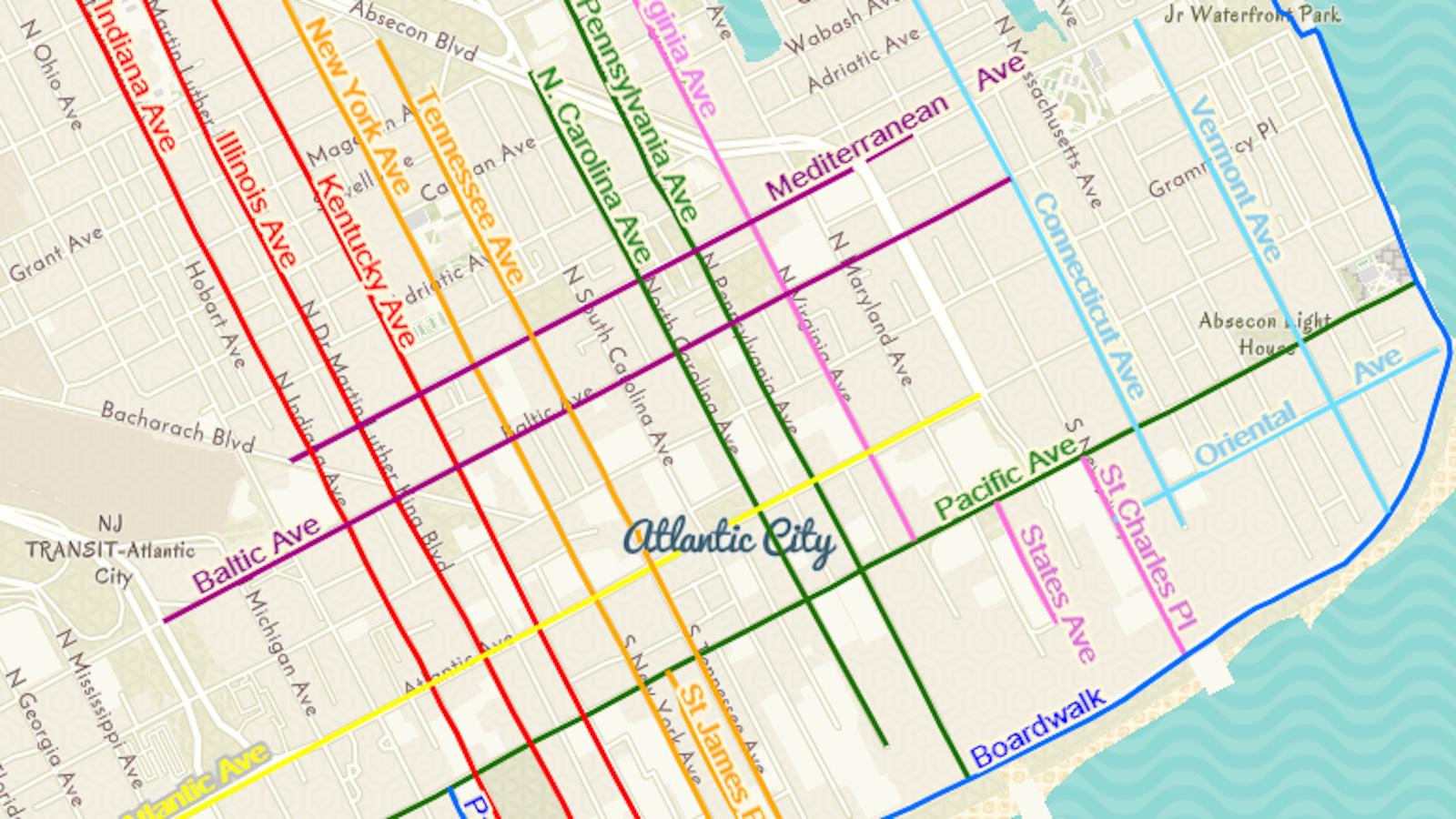
Monopoly is a popular board game that simulates real estate trading and management. The game features a board with various properties, utilities, and transportation spaces that players can buy, sell, and develop. The locations on the Monopoly board are based on real-life streets and landmarks in Atlantic City, New Jersey.
The street names were added to the game around 1929 by Ruth Hoskins, who had moved to Atlantic City and made her own copy of the game using streets where her friends lived. A local realtor named Jesse Raiford later assigned property values to each street based on actual real estate prices at the time, which is why the cheapest and most expensive properties on the board reflect the economic geography of 1930s Atlantic City.
For the most part, the locations on the board can still be found in Atlantic City, although some have undergone name changes or have been repurposed over the years. This post will chronicle the locations on the Monopoly board and their real-life counterparts.
Brown Properties
- Mediterranean Avenue: Originally called Arctic Avenue in early versions of the game. Charles Darrow changed the name to Mediterranean because he preferred the warmer sound. In the 1930s, this was a low-income, predominantly Black residential area.
- Baltic Avenue: Also part of a low-income neighborhood in the 1930s. The area has since been redeveloped and now includes a modern shopping mall.
Light Blue Properties
- Oriental Avenue: A street in the northeast section of Atlantic City with residential and casino-adjacent properties. In 2025, Hasbro renamed this property to Rhode Island Avenue on the game board, though the real street retains its original name.
- Vermont Avenue: A short street in Atlantic City. The Absecon Lighthouse, one of the tallest in New Jersey, is located here.
- Connecticut Avenue: Runs through residential and casino areas. Part of the street becomes Ocean Beach Boulevard, which connects to the Ocean Casino Resort and the Boardwalk.
Pink Properties
- St. Charles Place: The street was demolished when the Showboat Atlantic City casino was built over it.
- States Avenue: Connects to the Hard Rock Hotel and Casino along the shoreline.
- Virginia Avenue: Mostly lined with newer residential developments, running toward the casino district at the shoreline.
Orange Properties
- St. James Place: One of the shortest streets in Atlantic City, only a couple of blocks long near the shoreline. Ripley’s Believe It or Not museum and a pier sit at the beach end.
- Tennessee Avenue: Runs through central Atlantic City. Along with St. James Place and New York Avenue, these three streets now form “The Orange Loop,” a restaurant and business district named after the game’s orange properties.
- New York Avenue: Adjacent to Tennessee Avenue in central Atlantic City. Part of the Orange Loop district.
Red Properties
- Kentucky Avenue: Located in the business district of Atlantic City, lined with hotels and commercial establishments.
- Indiana Avenue: Formerly home to the Sands Casino, which went bankrupt and was demolished in 2006. The site was repurposed into Artlantic, a public art project.
- Illinois Avenue: Renamed Martin Luther King Jr. Boulevard in the 1980s. In the game, it is the most frequently landed-on property.
Yellow Properties
- Atlantic Avenue: A major thoroughfare through the city. Home to the Atlantic City Free Public Library, the hospital, and city hall.
- Ventnor Avenue: Extends beyond Atlantic City through Ventnor City, Margate, and Longport. Part of it in Margate has been renamed the Margate Parkway.
- Marvin Gardens: Misspelled on the board. The real name is Marven Gardens, a portmanteau of Margate and Ventnor. Parker Brothers acknowledged the error and apologized in 1995. The only property on the board not located in Atlantic City, it is a planned housing community from the 1920s in neighboring Margate City.
Green Properties
- Pacific Avenue: The closest major street running parallel to the Boardwalk. Lined with casinos, including Caesars.
- North Carolina Avenue: Home to the Resorts casino, along with older brick commercial buildings.
- Pennsylvania Avenue: A major street running through the casino district. The southernmost block has been renamed Danny Thomas Boulevard.
Dark Blue Properties
- Park Place: Named for a small park that once sat along the street. The park was built over by Bally’s casino. A plaque on the street commemorates the game’s connection to Atlantic City.
- Boardwalk: Built in the 1870s, the oldest boardwalk in the United States. It runs about four miles along the ocean. The Claridge Hotel sits at the corner of Park Place and the Boardwalk, the intersection of the two most expensive properties on the board.
Railroads
- Reading Railroad: A railroad that connected to Atlantic City. The company went bankrupt in the 1970s and was folded into Conrail. The route now operates as NJ Transit’s Atlantic City Line.
- Pennsylvania Railroad: A railroad that served Atlantic City. The company merged into other entities over the decades, but the rail infrastructure is still in use.
- B&O Railroad: The Baltimore & Ohio Railroad, the oldest railway in the United States. It never connected to Atlantic City; it served Midwestern and Northeast routes. It merged into the Chessie System in the 1980s and is now part of CSX Transportation.
- Short Line: Based on the Shore Fast Line, a streetcar service in New Jersey, not a full-sized railroad. A storm destroyed the line in the 1940s.
Utilities
- Electric Company and Water Works: Not based on specific Atlantic City landmarks. They represent the general utility companies that served the city.